Imagine a world if you will where professional wrestling/sports entertainment was the hottest thing around – when the initials WWF referred to the wrestling company and not the panda organization that sued them later. Just about anything and everything that had a WWF license was a license to print money. Well, while some of you might think that I’ve been drinking the strong stuff, that period actually did happen in the late-1990s and early-2000s. The World Wrestling Federation, on the verge of bankruptcy at the time, ultimately changed their product and made a ton of money as a result to become the media conglomerate that is known today as World Wrestling Entertainment. And while the current product is nowhere near as hot as it used to be, it’s still a very profitable venture and many products with the WWE license are still being made today.
Okay, I’ll dispense with the history lesson. Like any hot product, a ton of licenses get tossed around and you have the usual assortments of action figures, trading cards, and even video games. Wrestling video games are a varied type – some are good and some are really bad – but recent titles on the Sony Playstation and Nintendo 64 seem to give the genre a workable template that continues to see use today.
Okay, okay… no more history lesson. Eventually, Microsoft released the Xbox and a WWF game – titled WWF Raw Is War before being shortened to WWF Raw – was released on the system. How does it fare? Let’s find out.
My first experience with a WWF arcade game wasn’t the Wrestlefest game (because I’ve never seen it in arcades around my block) but rather the Midway-produced WWF Wrestlemania arcade game, a strange little beast that involved some of the more popular WWF wrestlers of the time competiting in Mortal Kombat-style wrestling matches (without all the blood and fatalities). For the time, it was a fun little game, but involved little wrestling. Years later, I come across a Royal Rumble arcade machine that I’ve only heard about and this was more like a wrestling game than the other one was. You could either play in straight matches or compete in the Royal Rumble match itself, which was a crazy experience in and of itself. This ought to be a fun game to bring home, right?
Eventually, THQ did bring it home to the Dreamcast. Unfortunately, chances are not many people got to play it because it was released somewhat late in the Dreamcast’s lifespan before Playstation 2 arrived and demolished Sega’s hardware dreams forever… which is a shame. In any case, a few years later (more like last year actually), I had managed to pick up a Dreamcast with a few games, which included this game. So I decided to give this game a go to see if it was as memorable as I remembered it… and the end result is… it’s okay, but lacking. How lacking? Let’s see here…
First there was X-Men. Then there was Marvel Super Heroes. Then X-Men came back and tussled with Street Fighters. Then it was Marvel’s turn. Then other Capcom heroes joined the fray. Now we get to Marvel vs. Capcom 2, where a whole bunch of fighters from both universes show up and beat the tar out of each in pixilated fashion. Most people consider it to be one of the finest fighting games ever made while others (myself included – see my Xbox review of the same game) blast it for being a unbalanced contest of who can pull off the more impressive combo. In either case, you were getting a pretty meaty package that was a blast to play among friends and fun times can be had by all.
Marvel Vs. Capcom 2, like most Capcom fighters, started life as an arcade machine and was eventually first ported onto Sega’s Dreamcast console before being shovelwared onto PS2 and Xbox consoles a couple years later. While I have already picked up and reviewed the Xbox version years ago (before it started commanding ridiculous prices on eBay), just a couple months ago, I was able to snag the Dreamcast version for a couple bucks. And after having played the game for a couple days, my thoughts are… well, let’s just go on.
In 2007, Power Rangers celebrated its fifteenth anniversary with a 2-part episode that united some familiar faces of the franchise’s past. Despite its intentions, the episode had left a sour taste in most people’s mouths that is rather hard to do away with. So in a vain attempt to salvage the anniversary, Disney has their gaming studios develop a couple games commemorating the franchise’s fifteen-year history; one for the Nintendo DS and another for the Playstation-2 and PC platforms. Both share a similar scenario (Rangers from different points in history team up to fight the bad guys), but the actual set-up and gameplay is different. For now, we’ll start with the DS version.
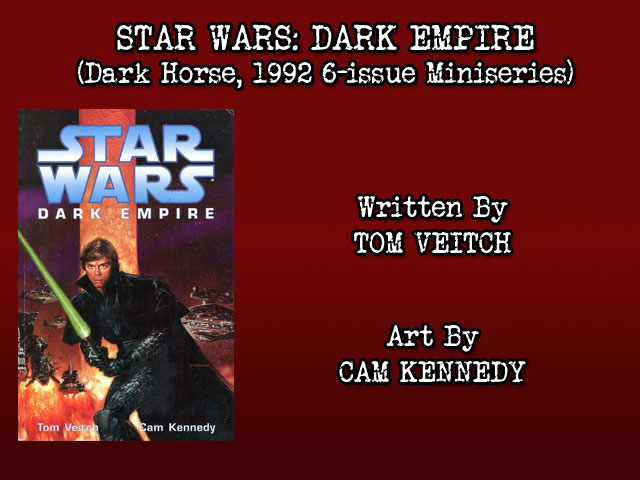
So this was the first piece of Star Wars Expanded Universe fare that I think I’ve read as a younger fellow. Oh, I have dabbled in the Marvel comics stuff and maybe that Splinter Of The Mind’s Eye novel, but in terms of new stories set in that galaxy far, far away that took the narrative beyond the Star Wars trilogy – there was only one – Dark Empire was the first thing that opened up. I wouldn’t get around to the novels until much later down the road, but the comics were easy reads… as were the video games that would come along later, but I digress.
Dark Empire takes place some years after Return Of The Jedi. The leadership of the former Rebel Alliance now head the New Republic and they’re still fighting the remnants of that evil Galactic Empire after all this time. The first thing you notice about this comic is the artwork, which has really rough-looking characters that somewhat resemble those classic characters you know and love, but updated to keep with the times. Luke Skywalker has darker-colored Jedi robes, foreshadowing the dark turn he would take as the series would progress. Leia has heir hair down. The various ships and setpieces are probably the real highlight of the art because they look a little better, but even to this day, I am baffled by the coloring, which seems very all over the place, cloudy, and doesn’t help the line art all that much.
As for the story itself… like I said, the Republic is still fighting the Empire and the Emperor is back from the dead in a new clone body, which makes me wonder if this was something that could’ve happened in whatever sequels would’ve followed if George Lucas would’ve gone in that direction. Luke takes a bit of a dark turn and things go to hell… but they eventually get better. For the time, I thought it was a fairly enjoyable little read and even coming back to it years after the fact, it might not be the one of the better Star Wars stories… and the subsequent miniseries, Dark Empire II and Empire’s End, actually turn out far worse than this one, but it’s an enjoyable little romp regardless.
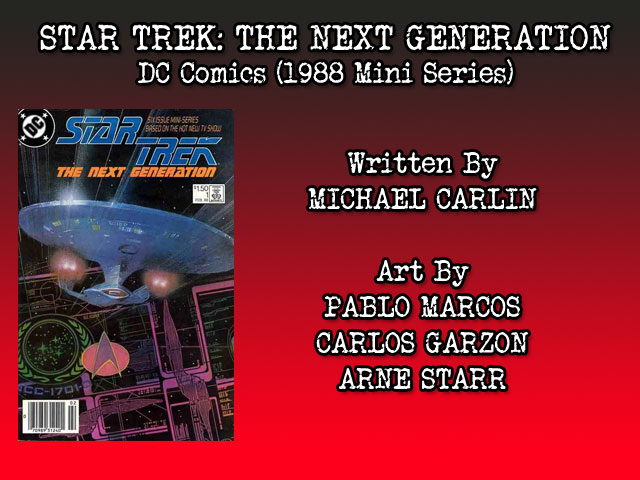
Star Trek: The Next Generation debuted in 1987 and became a surprise hit. DC Comics, at the time producing a successful enough Star Trek comic book, would eventually produce a miniseries based on the new show lasting six issues. Naturally, the miniseries is non-canon to the larger Trek canon, so put down your phaser canons because this thing is BONKERS.
The Enterprise crew get into the Christmas spirit or something and they meet Santa Claus. There’s a three-issue arc featuring Q as an absolute madman, which may or may not be far off from the actual character; who the fuck knows. Honestly, I feel like whoever wrote that second season of Picard read this thing and made old Q seem like this Q… almost. Fundamentally, the comic takes a lot of liberties with the source material and I’m not quite how much material they had to work with when they put this series together. But reading this stuff now and knowing how the series (as well as the franchise as a whole) would turn out afterwards, this feels like some whacked-out fanfiction written by someone who has no idea what they’re doing. And I’m not faulting Mike Carlin on this one; it’s entirely possible he had little to work with and thus needed to fill the blanks.
I’ll give him this much; I was thoroughly entertained throughout. This, along with the artwork making all the characters appear buffer and more seemingly well-built with Herculean physiques – they had spandex spacesuits at the time, so I’m sure the art direction was a Rodenberry wet dream. But listen, you can debate the continuity snags (Stardates has you assuming this takes place in the second season, but it’s clearly based on the first since Riker has no beard and Tasha is still alive) and some of the minor nitpicks, but the one thing you can’t accuse this of is boring. For six issues, you’re getting some of the more wacky takes on Star Trek that you’re gonna get, almost right up there with the old Gold Key stuff from back in the days. Don’t come into this with high expectations and you’re going to enjoy this one immensely. Highly recommended for the lulz.
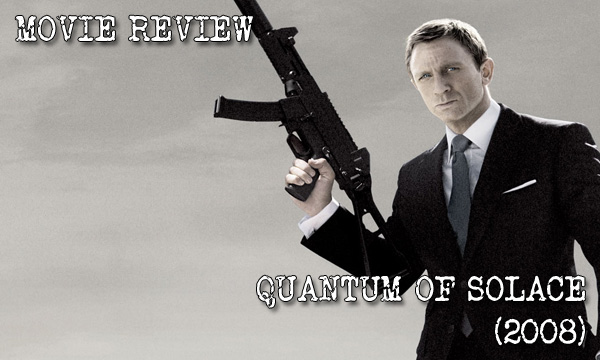
So I recently got to see the new Bond flick last night… and I liked it.
As a direct sequel to Casino Royale, the story pretty much picks up where that one left off, with Bond wanting revenge for the death of that chick who betrayed him… um yeah, that makes sense. Didn’t he say “the bitch is dead” in the last flick? Um, never mind. Logic aside, the movie has Bond going around the world killing leads all the while trying to get a clue as to who the organization is… or something. You know what, who cares? It’s a movie with some explosions, some action, some seducing ladies to bed, and a lady drowned in oil… because apparently Goldfinger isn’t available to supply gold paint… or whatever.
Despite my snarky comments, I really enjoyed the flick as a sequel. Is it as good as Casino? Probably not… I thought there were a couple of problems with the movie that kept it down a notch. For one thing, the final moments of the film pass by so quickly that you’re left somewhat unsatisfied… and there’re still some unanswered questions that they most likely will resolve in the next film… I know, it’s shameful.
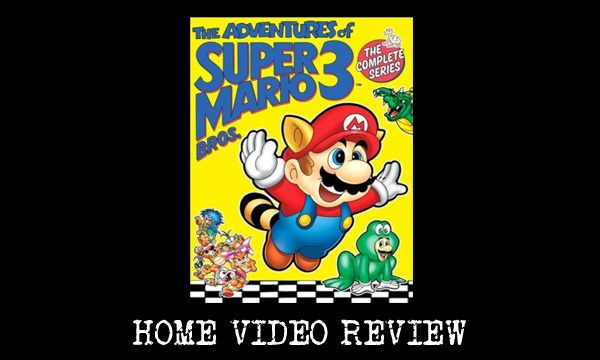
Yeah, this was a thing I stumbled across somehow once upon a time; a 3-DVD set compiling the entire Adventures Of Super Mario Bros. 3 series, which was basically a continuation of sorts of the old Super Mario Bros. Super Show, but without the live action bits and with an almost entirely new voice-cast, save for Harvey Atkin, who still does a solid King Koopa.
Sadly, the ol’ King of the Koopa has been sullied with his annoying, obnoxious kids whose names have been changed from the games to more… weird names that may have been drawn out of a hat. I don’t know why they changed the names; maybe the original names were too “on point.”
(Fun fact: the original Koopa Kids were play on pre-existing people. Morton Koopa Jr, for example, named after shock jock host Morton Downey Jr… which might explain the needless name change.)
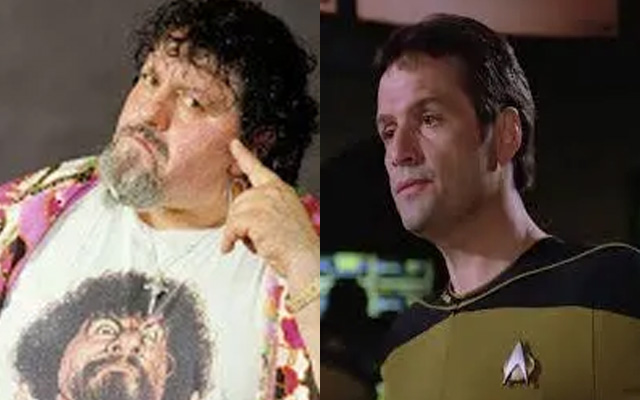
The rest of the new voices are alright. I thought the guy who voiced Mario was pretty good, but Lou Albano was the more “iconic” voice. You folks can keep your Charles Martinet for all I care. Captain Lou is mah Mario.
(Fun Fact: The guy who voiced Mario in this and the Mario world cartoon is Walker Boone, whom I later found out had played Leland T. Lynch, one of a billion chief engineers on the Enterprise in the Star Trek: The Next Generation first season episode, “Skin Of Evil.” Yes, the man who voices Mario was the chief engineer on the episode where Denise Crosby’s Lt. Tasha Yar was killed off by a tar monster. The more you know, I guess.)
Mario went from being voiced by Captain Lou to Enterprise-D chief engineer #213,829 before Geordi LaForge took the job on a permanent basis. Mama-mia! That’s a hell of a vocal resume!
Of the three Super Mario cartoons back in the day, this was the one I was least familiar with because I missed out on this one completely during my younger years. So this was a chance to finally catch what I was missing out on… which turned out to be not so much. Unlike the previous Super Show but much like the later Mario World cartoon, SMB3 stays true to the game it’s based on and doesn’t try to go for parodies of popular movies and such. The problem is that the show itself isn’t all that interesting otherwise. The episodes are your typical kids fare; there’s a minor problem that needs to be solved, our heroes need to solve it, and there’s a musical number that plays at some point. The songs have aged poorly and some of them seem to have been replaced with some bad generic rock tune of sorts.
The series is contained across two discs, with the third disc reserved for what the box calls the series bible, which has you navigating a bunch of things. It’s a bit of a fluff piece and anyone wanting something deeper is probably not going to find it here, but it’s better than nothing, I suppose, and considering the cheap price, it’s more than I would’ve expected out of a set like this.
For those wanting a piece of their childhood, this is worth it for the nostalgic value. I don’t know if it’s aged particularly well and the DVD set itself isn’t all that impressive, but it was fairly cheap, so I’d say go for it.
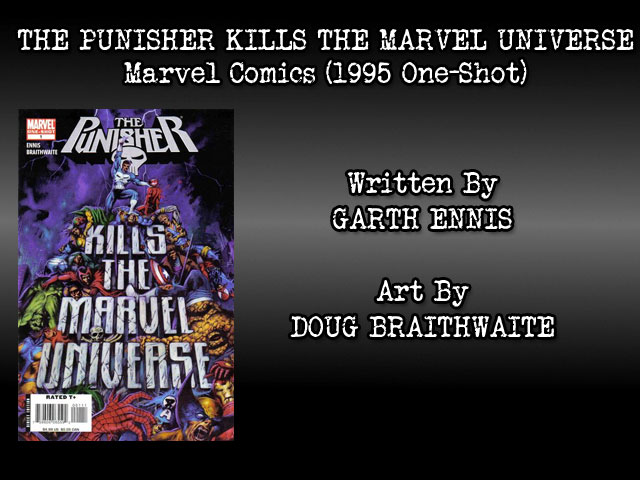
In 1995, Garth Ennis wrote a Punisher comic that saw Frank Castle’s family killed during a battle between the usual Marvel superheroes and an invading alien force. After the superheroes show no remorse for their actions and offer a pitiful apology, Castle goes ape shit and kills a few before he is arrested, taken to jail, broken out of fail, and offered a shitload of weapons and tech to kill all the heroes, becoming the same ol’ Punisher we all know, but with a decidedly different target.
Almost five years later, Ennis would pen a new Punisher mini-series that would be critically acclaimed and this one-shot would see a reprint, with a new cover by Ennis’ occasional collaborator, Steve Dillon. But I didn’t know any of this beforehand because I picked up the reprint. And so it was jarring to open up a Punisher comic by Garth Ennis and not have Steve Dillon do the art. Fortunately, Doug Braithwaite does a serviceable job, with reasonably proportioned characters and some decent looking setpieces.
And the story itself is actually quite brilliant; shifting the Punisher’s war on crime to that of a war on superhumans and basically telling the story of a man who won’t stop until all these heroes (and villains) are dead. If nothing else, some of the kills are pretty creative and the way the comic comes to its conclusion makes sense.
For what is essentially a glorified What If, The Punisher Kills The Marvel Universe is a pretty entertaining read if you just want a bonkers comic. Recommended.

 dtm666