BOOK REVIEW – The Rock Says (2000)

So… the Rock was the most electrifying man in sports entertainment. And after the success of Mick Foley’s first autobiography Have A Nice Day, it only made sense that the Rock should also pen a book of his exploits. This came out in 2000… and it’s only fitting that I’d do a review on this thing roughly ten years later and see how well it holds up.

Spoiler: it doesn’t.

Continue reading “BOOK REVIEW – The Rock Says (2000)”

GameFAQs Review – Sonic Classic Collection (Nintendo DS)

Sonic Classic Collection, the latest collection and re-releasing of classic 2D Sonic games from Sega, comprises the first four Sonic titles on Sega Genesis; the original Sonic the Hedgehog, Sonic 2, Sonic 3, and Sonic & Knuckles. In addition to these games, you also have the lock-on variant games Knuckles in Sonic 2 and Sonic 3 & Knuckles openly accessible from the start without having to unlock them after meeting certain conditions. Along with those games, you have a rather modest collection of Sonic-related illustrations that have been featured in countless other Sonic compilations as well as various other sources… including the Internet.

And that’s about it. No extra games or hidden features. What you see is what you get with Sonic Classic Collection and for the most part, this is actually not too bad. It more than makes up for the shoddy GBA port of Sonic 1.

Now it should be noted that these games aren’t port overs – they are basically a set of ROMs running off an emulator. As such, there might be cases of graphical blurring or some slowdown issues. But that doesn’t really distract from the gameplay unless you’ve logged in many hours on the original Genesis cartridges. All the Sonic games included play, look, and sound pretty much the same way as they did way back when… and for the most part, the games control rather well with the DS Lite’s dinky D-Pad. It’s a fairly decent emulator with no major complaints on my part.

It should be noted that the ROMS for Sonic 2 and 3 (and 3 & Knuckles) have been altered somewhat to remove the two player mode and option menus. This means a lack of multiplayer options, restricting the games to a single player experience only – which will no doubt disappoint some player hoping for quick 2-player games. Also, the removal of menus makes it more difficult (almost impossible) for the old cheat codes to be implemented, forcing you to “tough it out” the old-fashioned way. This may or may not bother some people.

Another annoying aspect is that the pause function is on the touch screen rather than mapped to the Start Button or any other button on the handheld. It’s not a crippling issue, but it’s a truly awkward implementation of something as simple as a pause button. Oh well.

Also in the case of Sonic & Knuckles, its unique and dramatic mid-boss theme was replaced with the messy mid-boss theme from Sonic 3. Strange.

To make up for the changes, a quick save function was implemented to the Sonic games that didn’t originally have one (i.e. Sonic 1 & 2, Sonic and Knuckles, and Knuckles in Sonic 2). This essentially allows you to save your progress and restart at the beginning of the last act you saved at. I haven’t fully tested this, but the quick save function does save any Chaos Emeralds you may have collected along the way. The sole drawback is one save per game, but that seems to work fine.

As Sonic 3 and its lock-on cousin already have save functions, they didn’t get the quick-save function, but that’s alright. They work just fine as is.

Overall, this is a fairly solid collection of Sonic games that show the series’ high point and in all honesty, Sonic on the go is always a good thing. Those who were long-burned by Sega’s butchering of the GBA port of the original Sonic many moons ago will find that Sonic Classic Collection does a fairly good job in redeeming the stain from Sega’s sleeve. Even though they’re merely emulated versions, I suppose that’s the best we could hope for in regards to maintaining the purity of the classic Sonics. Given the last time Sega attempted to port over classic Sonic to a Nintendo handheld, this collection more than makes up for it.

BREAKDOWN
Graphics: 8/10 (true to the Genesis originals – although some blurring may occur)
Sound: 7/10 (some minor audio issues and one changed tune, but otherwise well accurate)
Gameplay: 8/10 (classic Sonic fun plays good – missing multiplayer and sound test)
Challenge: 7/10 (all the Sonic games offer a fair, moderate challenge – seeking Emeralds is also fun)
Replay Value: 7/10 (lack of multiplayer disappointing, but Sonic games are still fun)

GameFAQs Review – Fighting Force 2 (Dreamcast)

Around August 2008, I picked up a used Dreamcast and several games along with it. Among the crop of games I got was Fighting Force 2. Of course, when I saw the game, I was ignorant of all the bad press it got… So I pop the game in the Dreamcast and for some reason the bloody thing didn’t read. It just kept going to the Dreamcast menu screen thing. So in any case, for reasons I have yet to comprehend (and yes, the disc was thoroughly cleaned), I couldn’t play the game. Maybe it was a blessing in disguise or divine intervention. Doesn’t matter now. All I know is that among the small library of games, I had one dud in my collection.

Now as luck would have it, someone had a working copy of Fighting Force 2. And given that I really wanted to see for myself if I missed anything despite the bad press, I borrowed his copy and gave it a go. A couple days later, I returned the copy of the game and offered my friend a box of matches and a small container so he could burn the game away as well as the sin of having picked it up.

Yeah, that should tell you everything about my thoughts on Fighting Force 2 and I could end the review right here. But I’ll keep going.

For the most part, Fighting Force 2 takes the rather harmless-but-ultimately-boring gameplay mechanics of the original Fighting Force and shoves it down the proverbial black hole of doom to regurgiate the awful mess we’re stuck with today. Instead of four different characters with varying stats and attacks, you’re stuck with one character and he moves like a turtle… quite possibly slower than that. To make up for the slow speed, your character has the ability to make everything he touches explode into a ball of flames after a few hits. What sense does this make? Absolutely none. Does it help my chances? Of course not.

And for some odd reason, the exploding chairs yield weapons such as pipes and guns which can be used against your enemies, who are easily subdued by these weapons that are literally laying all over the place. Indeed, your only real difficulty in Fighting Force 2 lies in the awkward controls, jittery camera (not too bad in large rooms, but problematic in smaller ones), and overall generic gameplay that proves to be a fine test in how long you could fend off boredom.

Looking for a game with great sound? Look elsewhere. While the sound quality on Fighting Force 2 is admittedly crisp and clear for the most part, there’s very few bits of music to be found here and what’s there isn’t all that memorable. The only real positive I could give this game is in the graphics. Aside from some clipping issues, the game looks fairly good… by Playstation standards. By Dreamcast standards… it’s tolerable at best… Perhaps I’m being too critical. The models and environments are neatly rendered, but not much more than that.

It’s truly unfortunate that Eidos and Core dropped the ball in porting over this game over to the Dreamcast. It seems like they just copied-and-pasted a Playstation game onto a GD-ROM disc, did a couple minor touch-ups, and BOOM! Brand new game. Now, I understand a number of Dreamcast games that started off as Playstation games were like this, but it’s hard to believe that the quality was just THIS bad. It seems like whoever was working on this simply didn’t care about the final product.

Anyone who is looking for a good Dreamcast game should not be picking up Fighting Force 2. Anyone looking for a further fix of Fighting Force should just play the first game again. Anyone looking for a fun activity should just stare at the wall… yes, staring at a wall is MORE FUN than Fighting Force 2.

BREAKDOWN
Story: 2/10 (the story is unmemorable and dull – not much to it)
Graphics: 5/10 (the graphics are okay – slightly higher-resolution version of a Playstation game, but that’s about it)
Sound: 2/10 (little music, repetitive grunts and explosions, please make it stop)
Gameplay: 1/10 (touchy, awkward controls – boring gameplay – unstable camera)
Challenge: 2/10 (weapons all over the place make this a cinch to beat – if you want to)
Replay Value: 1/10 (just play the original Fighting Force instead)

OVERALL:1/10

GameFAQs Review – Ms. Pac-Man (Atari 2600)

Pac-Man on the Atari 2600 is considered to be the single most disappointing home conversion of an arcade machine in the history of video computer electronic entertainment. No matter how bad any other home port turned out, it didn’t contribute to the near-decimation and annihilation of the North American video game market. Is that a bit of stretch? I’d like to think so, but others do believe this statement and looking at Pac-Man as ported to the 2600, it’s not hard to see why.

While the original Pac-Man was something of a disaster, the same cannot be said for Ms. Pac-Man, which got a fantastic port on the Atari 2600. It still got that strange color scheme with the blue background, but the game somewhat resembles Ms. Pac-Man as it appeared in arcades. The sprites are a little more refined (even though there’s still that flickering issue), the mazes are almost similar enough, there’s fruit bouncing around and not vitamins, the sound effects are fairly close to matching the original sounds (as opposed to the previous port’s strange deviations), and the gameplay and functionality is similar to the arcade version. Everything still looks blocky, there are no dots but dashes, but that’s to be expected considering the system. The important thing is that when you pop this in and you look past the visual differences, you know that you’re playing Ms. Pac-Man and not some perversion of computer programming that tries to pass itself off as genuine.

Much like the arcade version, Ms. Pac-Man sports up to four different mazes, which increases the variety and challenge in the game and is an overall improvement over the original Pac-Man, which only had one static maze. Your main goal is to eat all the dots, lines, whatever the case may be and move onwards. You don’t have the intermission sequences that play every couple levels or so, but the core elements are there and… again, it’s a huge improvement over the previous port… which wasn’t very good.

There’s not much more I can add to the matter; it’s Ms. Pac-Man on the Atari 2600 and it’s the port that people wished Pac-Man got. Everything that went wrong in that game is done right here and you can’t ask for more than that. Not mention that this is just a fun game to play. Ms. Pac-Man is a game you can find all over the place and deserves a good home among your Atari library if you have one. Great game, give it a go.

BREAKDOWN
Graphics: 8/10 (more refined sprites, closer accuracy to source material)
Sounds: 7/10 (sounds closer to what you’d get at the arcades)
Gameplay: 8/10 (plays and functions similarly enough to the arcade game)
Challenge: 8/10 (four mazes provides more variety, challenge)
Replay Value: 6/10 (plenty of fun to be had here)

OVERALL: 8/10

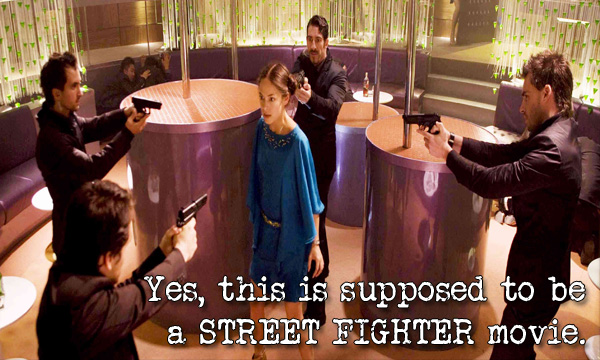
MOVIE REVIEW – Street Fighter: The Legend Of Chun-Li (2009)

The first live-action feature film adaptation of the Street Fighter II arcade game (the one with Belgian star Jean-Claude Van-Damme playing the role of American soldier Guile) was a rather significant departure from the humble narrative of the source material. While a number of SF fans tend to dislike the movie because of its straying from its roots, I actually enjoyed the old Street Fighter flick. Was it a great movie? Not necessarily, but it was still a fun little action movie with a moderate dose of camp and cheese. At the very least, if nothing else, a number of the characters at least resemble their video game counterparts in some form or another.

But with 2009’s Street Fighter: The Legend of Chun-Li… this is something else entirely.

The Legend of Chun-Li is a basic, cookie-cutter martial arts action movie with a pretty typical plot (girl fights off drug syndicate in order to avenge her father’s… kidnapping – weak.) and your usual cookie-cutter action sequences common with kung-fu flicks these days. This is barely a Street Fighter movie – if you were to have changed the title, I probably would have thought it to be nothing more than another wire-fu movie that seems to be the norm with most Asian folks these days, but even at its most bare-bones level, it still manages to be lacking in many different things.

On a sidenote, some of the visual settings featured in the flick are, honestly, quite nice and gives you a nice feel of the cityscape. Sadly, most of the important stuff takes place at night, which really kills the beauty and splendor of many settings.

As a generic action movie, it’s a worthwhile moment if you simply turn your brain off. But as a movie based on a popular video game series, it’s severely lacking. Practically none of the characters taken from the game remotely resemble the source material and what personalities they do have seems very wooden and not the least bit awe-inspiring. Say what you will about the Van-Damme flick and the liberties it takes with the characters, but they at least attempted to do the characters justice, even if the results are hit and miss. Balrog the cameraman did have a boxing background, unlike the brute thug with a bazooka carrying the Balrog name… well, at least, you won’t have to change his name overseas because it’s not the boxer, it’s just some big guy.

Just about the only character they did manage to get right was Vega… and he only appears for a sliver of the movie and is easily defeated. Weak.

And most of all, there’s hardly any Street Fighter-esque fights involved – say what you will about the Van-Damme flick, but at least they were able to translate some moves to live-action celluiod – albeit poorly translated, but hey, they tried. Here, you only get a faintly-subtle Spinning Bird Kick and a fireball. The rest of the fights are generic wire-fu stuff that has been overdone to death. Weak.

Overall, this just seems like a disappointment for what is supposed to be a reboot of the Street Fighter movie franchise. It makes you wonder why they were bothering to make a movie based on the video game if it’s going to have nothing to do with the video game. If you really need your fix of live-action Street Fighter, I suggest tracking down the Van-Damme movie from the nineties instead… or even better, just go online and watch the Street Fighter: Later Years online show. Even that’s a better product than this.

AVOID.

GameFAQs Review – Hat Trick (Atari 7800)

Hat Trick… by definition, it’s attained when a single player scores three goals in a game. I guess the name makes sense considering the game is essentially one-on-one ice hockey (or two-on-two if you count the goaltenders). Unfortunately, that’s the only semblance of hat tricking that you’re going to be getting from this game… a game that is less super than the box cover implies.

Originally a fairly popular arcade game released in 1984 by Bally Midway, Hat Trick makes a somewhat smooth transition to the Atari 7800 by replicating the arcade experience with little trouble. Each game lasts about three minutes and the goal is to score more goals than your opponent before time expires and the zamboni machine comes out. In essence, it’s the most basic form of ice hockey you could get. A fair enough concept for a 1984 arcade game, but a bland concept for a 1987 home video game system.

For the most part, the game is playable, responsive, and relatively simple to learn. Both your player and goalie are controlled by the joystick, while the buttons shoot the puck. The set-up works well enough and the game isn’t necessarily broken or anything, so that’s fine. The graphics in Hat Trick are decent enough; everything looks like what it should and the simplistic nature doesn’t really distract nor does it enhance the game. The sound is somewhat alright, although the jingles are irritating to say the least.

Hat Trick is best played with two players, because the computer on Novice level is an absolute joke. Alternatively, the Expert level is fairly competent and takes some skill to defeat.

The main problem with Hat Trick is that as much fun as it was to play the game in the arcades, it’s significantly less so to play at home. Although the game is better than what you would find on, say, the Atari 2600, it pales in comparison to the hockey titles gracing the Nintendo Entertainment System, mostly notable Nintendo’s Ice Hockey and Konami’s Blades of Steel. In an age when it was possible to play video games that featured multiple teams to choose from and full 5-on-5 ice hockey games with the standard rules in place, Hat Trick seems a bit antiquated and lackluster.

Don’t get me wrong. Hat Trick is a competent enough game that plays well enough and can be fun for a few minutes, but isn’t neccessarily good enough to keep your attention for long. Don’t bother with this one.

BREAKDOWN
Graphics: 6/10 (recognizable players and goalies, decent but not great)
Sound: 3/10 (terrible music complements average sound effects)
Gameplay: 5/10 (straightforward and responsive; nothing more)
Challenge: 5/10 (very easy Novice mode, somewhat hard Expert mode)
Replay Value: 2/10 (you’ll drop this quickly for a better game)

OVERALL: 4/10

GameFAQs Review – Street Fighter III: Double Impact (Dreamcast)

A quick look back at the history of STREET FIGHTER: The first game was released in 1987 and was a bleep under everyone’s radar for being frustrating to play despite presenting an innovative 6-button set-up. The second game came out in 1991 and wowed everyone with its smooth fighting mechanics and slick gameplay to the point where an entire genre of video game was born. And then… we got a whole bunch of prequels, updates, sidegames, puzzle games, and just about everything but a clear cut Street Fighter III. Jokes were made about Capcom not being able to count to three – which is actually quite funny in hindsight when you think about it, because this is the same company that has churned out Mega Man sequel after Mega Man sequel on the NES, which proves that they can count just fine, but let’s run with the joke for a minute, shall we?

When the year 1997 rolled around, it proved to be a monumental year for video games. Why? Because Capcom finally learned how to count to THREE… okay, joke over. And people were mixed in its reception. Some liked it, some hated it, but most agreed it was different from most Street Fighters played before… okay, not really, but still… at least they can count to three. Can’t wait until they count to Number FOUR!

Um, sidenote: It wouldn’t be until 2009 that Capcom would release a Street Fighter IV… which turned out to be Street Fighter II in 3D! Lame.

Anyway, all kidding and snarkiness aside, Street Fighter III was released and later got a slight revision called Second Impact… and then got another revision/sequel/remake called Third Strike, which is considered by most to be one of the finest fighting games ever developed and I have to agree. But in the interim, Capcom released both SF3 New Generation and SF3 Second Impact onto a Dreamcast disc almost appropriately titled Double Impact. Sadly, there’s no Jean-Claude Van-Damme to be found… oh wait.

Continue reading “GameFAQs Review – Street Fighter III: Double Impact (Dreamcast)”

GameFAQs Review – Vulgus (Arcade)

Vulgus is a 1984 vertical-scrolling space shooter and is best known for being the first-ever video game developed by Capcom, an obscure video game company that nobody’s heard of… they churned out a few arcade games that made tons of money… yup, never heard of them.

Right, back to the game…

Given that Vulgus is an early game, its mechanics are rather simplistic. You control a little spaceship and must battle alien forces attempting to take over the world in an endless struggle. Ah yes, one of those scenarios. Never gets old.

There are no power-ups or weapon boosters; only your basic cannon and a limited number of missiles (that you can collect more of along the way). There are various items, but these serve to alter the enemies you face, whether it be their speed, firepower, or ship design that changes. Without reading any instructions or familiarizing oneself with the controls, Vulgus is very easy to get into and understand. The premise is simple, the difficulty is decent, and the controls are competently responsive. So it’s a whole straightforward affair.

For a title that came out in 1984, Vulgus looks pretty decent with well-defined backdrops and smoothly-animated spritework. The levels are dull though; you’re on a sandy world, then over a body of water, then outer space, then the whole thing loops again, but with a new wave of enemies. The game looks fine for the most part, but it can get boring after a while.

The sound in Vulgus is the game’s sole low point. The sound effects used in the game are pretty bad and the “music” playing in the background is roughly ten notes long and also annoying. This “tune” is the only piece you’ll be hearing throughout the game and it keeps on going until the game ends… or until the power goes out. Whichever comes first.

Although it’d be difficult to find Vulgus at an arcade these days – finding an arcade is difficult enough these days, actually – it has appeared on a number of Capcom-released compilations, most notably the Capcom Classics Collection release on PS2 and Xbox. While the game is ultimately unspectacular and antiquated, it is a fine first effort from the company who would eventually spawn a dozen other popular franchises and is worth a few playthroughs at best. If you do get a chance to play it, then do so. You’ll actually like it… somewhat.

BREAKDOWN
Graphics: 8/10 (decent graphics, but little variety)
Sound: 2/10 (droning tune and awful sound effects)
Gameplay: 9/10 (keeps it simple, controls well, competent gameplay)
Challenge: 7/10 (fairly difficulty by SHMUP standards, but constant)
Replay Value: 6/10 (dull, generic, but quite fun actually)

OVERALL: 7/10

GameFAQs Review – Astro Warrior (Master System)

An early Sega Master System released in 1986, Astro Warrior is another in a long line of old-school space shooters that have very basic controls, very basic gameplay, and tends to be not all that interesting in the long run. And while I tend to frown on these games from a reviewing standpoint, I’d be lying if I said I didn’t have any fun with them. After all, most people will recall that games such as Space Invaders or Galaga were fairly barebones shooters and yet they were still fun. However, those games were released in arcades in the late-1970s or early-1980s and were considered trendsetters for what they established in the gaming world back in those days. Astro Warrior was released much later during a time when more sophisticated shooters were on the rise, both in arcades and home consoles.

Astro Warrior has you in the role of a space pilot who must deal with the evil alien forces trying to take over the universe or something. Much like most basic shooters, you move your ship with the directional pad and shoot with one of the two fire buttons. You’ll collect power-ups that will boost your speed as well as your firepower, including tri-shots, laser beams, and Gradius-style multiples that increase your firepower. As per the case with most shooters, at the end of each level, you’ll face a boss and must defeat him to move on to the next level.

For the most part, Astro Warrior pretty much nails the basic essentials of a SHMUP and a video game in general. The controls are pretty responsive, simple to understand, and easy to learn without reading any manuals or FAQs. The graphics are a nice piece of work and while they may seem generic (and they are), they are actually a bit more detailed, colorful, and the scrolling is somewhat smoother than what you’d find on the NES during those days. The sound quality is a little lacking, but I like the tunes in this game, so it’s not terrible.

The game only has three levels altogether and once you beat the final level, you repeat back to the first, this time with the difficulty increased somewhat. This is one of those shooters where you really need to collect as many power-ups as possible and pray that you don’t die later on, because the game can get plenty tough if you’re careless. Once you memorize patterns, it doesn’t seem all that harder, but the challenge is still there.

Overall, Astro Warrior is a fairly decent game that will entertain a few people that want a quick gaming fix. The more hardcore SHMUP fans among you might look past this game due to its simplicity and short length, but I would recommend giving this game a try.

BREAKDOWN
Graphics: 7/10 (generic looking, but still rather nice)
Sound: 6/10 (good tunes, but crummy sound)
Gameplay: 7/10 (controls functional, fairly basic gameplay – short variety)
Challenge: 8/10 (usual shooter difficulty – only three levels and they loop)
Replay Value: 4/10 (not much to hold you over – but still fun unless you have better games)

OVERALL: 7/10

GameFAQs Review – Teenage Mutant Ninja Turtles: Turtles in Time Re-Shelled (Xbox 360)

So a friend of mine had downloaded the newest TMNT game at the time: a modern-day remake of the classic brawler “Turtles In Time”. The remake, titled Turtles In Time Re-Shelled, is based on the arcade version (that I never played) rather than the expanded Super NES version (that I did play), so for the sake of curiosity (and to save myself the cash), I’ve had the chance to invade his domain and give the game a go a few times.

Cowabunga, right? More like Cowa-Dunga.

As a whole, the old-school side-scrolling beat-em-up brawler is quite possibly the most perfect example of a genre following the KISS (Keep It Simple, Stupid) philosophy: you have a jump button and an attack button, you keep moving right while stopping to dispatch enemies, and fight the boss at the end of the level. Rinse and repeat several more times. While not necessarily deep gaming experiences and can get pretty boring after extended plays, they are entertaining little things and are more fun when played with friends.

Re-Shelled, for the most part, maintains this level of simplicity with its fair recreation of the experience, but then destroys it by introducing 3D combat, meaning you can attack in eight directions. It’s mind-boggling, it doesn’t really work that well, and sometimes the hit detection is relatively weak. You also have a double-jump ability that is, for all intents and purposes, pretty useless and you’ll probably forget it’s even there unless you pull it off by accident. Aside from those changes, Re-Shelled plays similarly enough to Turtles In Time, but won’t really take that long to finish. Probably an hour at best, if you even stick around that long.

Yeah, they did add a Survival mode to the game… but it’s the same game all over again. An option to play the original “Turtles In Time” would have been nice, but I guess that’s rather impossible – since Konami was the original creators of the game.

Graphically and audibly speaking, Re-Shelled is terribly unappealing. While they tried to mesh the cartoony-style with the more hard tone of the recent TMNT movie, it doesn’t really work that well. Everything looks dull and drab, the animation is not all that great, and there’s virtually no color to be found; just the mere pretense of color. The voice acting, music, and sound effects in Re-Shelled are also far below par; absolutely devoid of life and energy. The music, in particular, is completely dull and very un-TMNT in its tonality. Honestly, whenever I’m listening to the music in this game, I can’t tell if I’m playing Ninja Turtles or Cheetahmen.

The only good thing I can say about this game is that you could play four players locally or online. Although I can’t really comment on the online portion, the game does get fun with the presence of friends… but even then, you’ll probably break out the old SNES cartridge and play that instead.

If you’re still on the fence as to whether Re-Shelled is worth the money, try the demo out. But I strongly urge you not to fork the cash. At 800 Microsoft points, Re-Shelled’s price is a bit steep for what is essentially a barebones, third-class remake of an arcade classic. Your best bet for pure “Turtles In Time” action would be to get the Super NES version, which is the best version of the game despite being two-players. Even the arcade port included in TMNT3: Mutant Nightmare with its butchered sound is a better alternative than this half-shelled attempt at a remake.

BREAKDOWN
Story: 7/10 (same as the original Turtles In Time, no problem)
Graphics: 4/10 (dull, drab, colorless, not very appealing)
Sound: 3/10 (an audible nightmare, music is pretty bad)
Gameplay: 3/10 (8-way fighting doesn’t work; wonky hit detection, lame)
Challenge: 5/10 (not too tough; can be beaten in an hour’s time)
Replay Value: 3/10 (fun factor lacking despite two extra modes)