COMIC REVIEW – Power Rangers: Soul Of The Dragon (Boom Studios, 2018)

(2023 Update: For some reason, I kept refering to the title as Sins Of The Dragon rather than Soul Of The Dragon. This has since been corrected.)

So anyone who has followed this blog have noted my somewhat “stern” criticism of Kyle Higgins’ obsession with JDF to the degree that his entire run has been all about him. I could say it’s all about “Tommy” and such, but let’s be honest. It’s all about that JDF wankfest. On a similar note, those same people who followed this blog will also have noted that I don’t particularly care for JDF as a personality. Countless posts can be found to further corroborate this point.

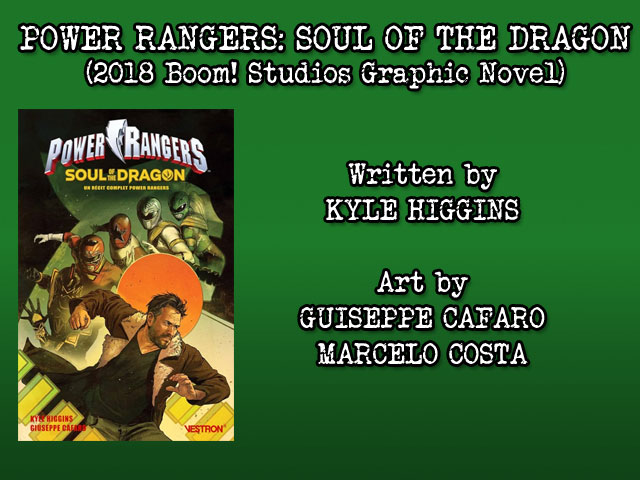
With this in mind, I came into Soul Of The Dragon – the first one-shot graphic novel in Boom’s Power Rangers line – with a bit of trepidation, but to my surprise and utter delight, what I got was actually a pretty decent, somewhat low-key story about an aged Dr. Oliver, past his prime, searching for clues as to the whereabouts of his missing son. There are familiar cameos, there are flashbacks and references to past events, there’s some twists and turns that seem somewhat obvious if you’ve been following the main series for a while, but it makes sense within the context of the story.

The whole thing is basically a last hurrah for the Tommy Oliver character before he passes the torch, so to speak. And while it isn’t the Old Man Logan approach that some folks would have wanted, it is nonetheless a satisfying final chapter for the franchise’s most popular character… Finster.

The artwork is interesting, with an attempt to give these characters as close to a resemblance to the actors who portrayed them as possible. In this regard, it’s a mixed bag; sometimes, they nail it and other times, not so much. As a whole, the art tends to be a bit rough, sometimes feeling as though it was drawn on a sketchbook quickly and color was splashed on later before it went straight to print. You see this often with the characters, though the scenery isn’t too bad either.

Soul Of The Dragon is probably Kyle Higgins’ best work. It’s a simple but effectively decent story, a good read, and gives Tommy a good last hurrah that lacks the ballyhoo people would’ve liked and was better for it. A highly recommended read if you want a quick PR comic to read, and that’s the highest praise I’ve levied towards the Boom run thus far.

COMIC REVIEW – Power Rangers: Aftershock (2017)

Aftershock is a weird little thing. It was basically Boom Studios’ attempt at tying into the recently released Power Rangers reboot movie, but rather than go for a movie adaptation that would’ve expanded on some ideas or presented some new ones, they opted for a pseudo-sequel thing that served as a follow-up to the film… and it’s not very good.

Here’s the deal. You have a movie tied to a license you have, you want to make a tie-in book, but you can’t do anything that introduces new lore because that’s what sequels are for and anything you add to the lore will more than likely be jettisoned because anything on screen takes precedence over the written word that only some hobbyists will bother to read. In fairness to Ryan Parrott – a guy who has since become the defacto Power Rangers comic book writer – he tried to put out the most compelling story he could for this one shot and perhaps plant the seeds for further adventures that could be explored in comic book form.

The problem is that the story is largely uninteresting. Reanimated putties, convicts merging with Goldar dust, and “what’s the deal with that lady” aren’t exactly compelling plot points. The Rangers dealing with some of their personal stuff might seem like basic character development, but it feels like spinning the wheels in place; doing just enough to give the impression of growth, but not enough that it feels like proper growth.

At the very least, the art is pretty solid; some muted colors aside, the characters do resemble their movie counterparts just fine (right down to the same clothes, coincidentally enough) and the overall tone of the world is fairly recreated. It’s just too bad that the glue that keeps Aftershock from falling apart – the plot – is fairly weak; so much so that the included sampler of the first issue of Boom’s MMPR comic comes across as a stronger story by comparison.

COMIC REVIEW – Star Trek: Countdown To Darkness (2012-2013)

Much like the previous film, Star Trek Into Darkness – the overall twelfth Trek film and the second in the Kelvin Timeline trilogy of films – got its own prequel comic book series in the form of Countdown To Darkness… and in hindsight, this one hasn’t aged all that well.

Don’t get me wrong; as a story in a vacuum, it’s a fairly traditional Trek story involving a trip to a new planet, the discovering of a reimagined classic character, the depiction of Klingons in this new universe, and an otherwise, fairly entertaining romp. There are some minor inconsistencies in terms of canon – the mention of a previous Starship Enterprise before the one featured in the movie, for example… which I don’t believe ever made it to Kelvin canon – but as a standalone adventure, it’s a perfectly adequate Trek comic book.

As a tie-in comic, there are a couple plotpoints that tie in to the movie in question, but these are mostly related to comments made in passing in the film. Unlike the first Countdown miniseries or even the Nero miniseries that came afterwards, there’s no real reason to dive into this one expecting anything that would further your enjoyment of what has since become a somewhat divisive motion picture.

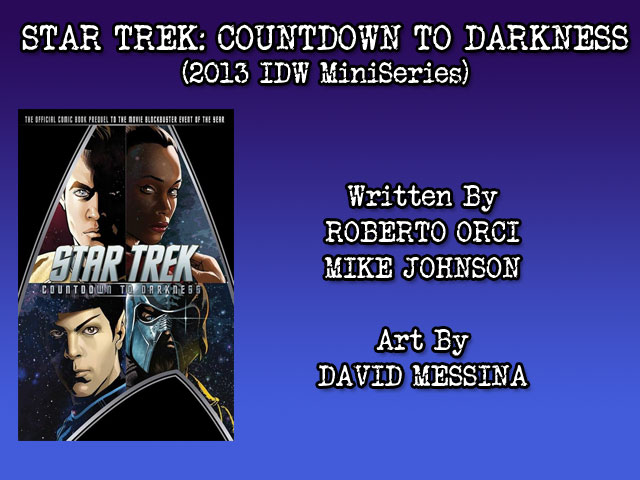
David Messina’s artwork is still pretty much a highlight to these comics and pretty much drive the series onwards. But he’s provided artwork for many superior Trek minis. Not quite his best work, but still pretty good.

Countdown to Darkness is fairly basic Trek fare and an underwhelming tie-in comic.

COMIC REVIEW – Star Trek: Nero (2010)

The other Trek 09 prequel comic miniseries focuses on Nero and what he’s been up to in between the prologue and the rest of the movie many years later. Beginning shortly after George Kirk sacrificed his ship and his life to save the fleeing crew, Nero and his ship are soon ambushed and captured by Klingons, who somewhat resemble the Klingons we’re familiar with when they don’t have their helmets on.

A lot of the Klingon stuff is based on deleted scenes from the movie and Nero’s band eventually make their escape, but there is an additional element that comes into play that gives Nero the answer to where and when to find Spock. I won’t spoil it here, but it is a nod to another Star Trek movie that I thought made quite a bit of scene in the larger picture and was a nice fit here.

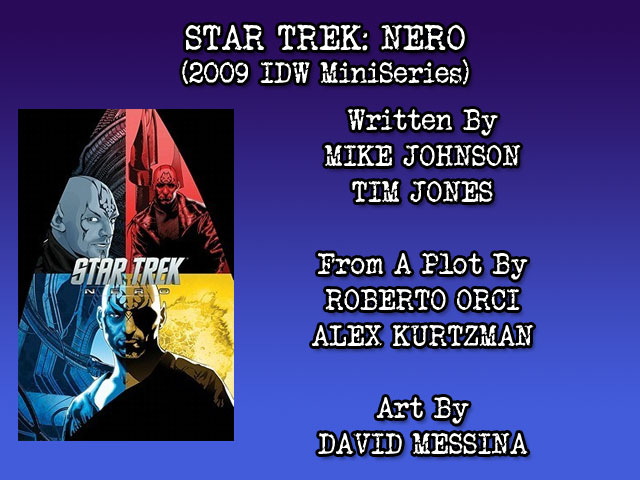
David Messina returns to art duties here and he hasn’t missed a beat. The same kind of colors and character portrayals are pretty spot-on in his own stylized way and his interpretation of the Klingon ships as well as the battle at the end of the series is pretty good,.

Nero isn’t quite as good or as essential as Countdown, but it’s still a pretty good read and fills in the gap nicely between point A and point B.

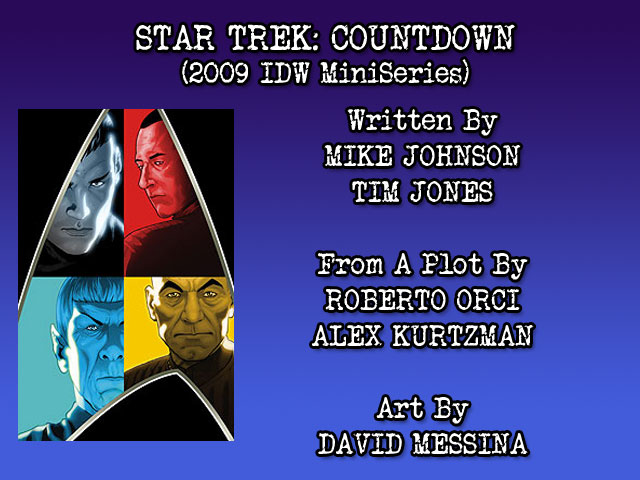
COMIC REVIEW – Star Trek: Countdown (2009)

2009 saw Star Trek get a “reboot” of sorts in the form of what is now known as the Kelvin Timeline.

The story of the Kelvin Timeline involves time travel that created an alternate reality so that these movies can co-exist with the “prime” universe of the previous Trek shows. And so a comic miniseries was conceived to give us some backstory as to how we got to t his point… and while the more recent Picard series (or as I’d prefer to call it, Blunt Talk: The Next Generation) has effectively curtailed Countdown’s chances of (already non-existent) canonical status, when it comes to giving that generation of Trek a proper sendoff while also leading us to the next Trek era, Countdown has it nailed.

It tells the story of Nero, a humble minor who assists Spock in attempting to save Romulus from the expanding supernova, but when that doesn’t happen, we see his descent into madness and the origin of his mining ship, the Narada. In addition, we get appearances from Next Gen characters such as Jean-Luc Picard (now an ambassador to Vulcan), Data (revived in B4 and now Captain of the USS Enterprise-E), and a couple others even. And they’re all true and consistent with how the characters have been portrayed all these years, which is more than what I could say for BTTNG.

This series was my first exposure to artist David M|essina, who had done a prior Trek mini for IDW and would eventually do art for several more Trek series. I like his style; his depiction of the characters are true to form while being somewhat stylized, the various space settings and ships look fairly accurate to what was on screen, and the choice of coloring to create a somewhat somber tone for the book, yet retaining some of the old TNG movie aesthetics is much appreciated.

A pity that this couldn’t have been used as a backstory for what would come after and we got Blunt Talk: The Next Generation (a.k.a. Star Trek: Picard) instead, because in terms of not only providing the backstory for two of the film’s key characters, but also giving us a satisfying farewell to the Next Gen crew, Countdown has it nailed to a tee.

COMIC REVIEW – Superman #19 (Jan. 2020)

This comic book is also a piece of shit.

Continuing from last issue’s ridiculously retarded plot thread where Superman reveals his identity as Clark Kent to the world, we have the very unrealistic reaction of everyone being happy for him and his brave act, Perry White “firing” Clark Kent and hiring Superman as a staff writer… because that makes sense. And then he gets into a fight with Mongul on the…

You know what? I don’t care. This whole thing is fucking stupid.

Anyone remember when DC tried this outing of Clark Kent/Superman a few years back with that equally shitty TRUTH story arc? Anyone remember the reaction to that sort of thing. Perry fires Clark and Clark goes down on his luck… and that’s before shit hits the fan. Anyone remember when Marvel outed Spider-Man for that Civil War garbage and then everything went straight to hell with him? Does this fucking hack that people still believe is a good writer forget about the time he outed Daredevil and the consequences that came afterwards? Now, all of a sudden, Supes publicly does away with the whole secret identity thing and everyone is… happy for him? Why?

If this were a realistic situation, people would be genuinely pissed off about this… because the guy who was writing the news in their favorite newspaper was really the guy making the news this entire time. It makes you wonder if anything out of that newspaper could be considered legitimate news since they’ve been harboring someone who has been making the news that made the newspaper what it is, today. Honestly, that should’ve been the take we’d go with here. We’re living in an age of fake news this and sensationalist media that where everything is questioned and debated… why not play up on that by having people question the integrity of the Planet?

It wouldn’t have made this story any better, because fuck, nothing will… but it would’ve been an interesting take, at least.

The artwork in general isn’t anything worth mentioning. It’s fine for what it is and quite frankly, anything that doesn’t look horrendous is fine by my book. However, even if this had some of the most beautifully-drawn and colored comic panels in the history of comics, it wouldn’t be enough to turn this turkey dung into something worthwhile.

In conclusion, Superman’s current arc is still a piece of shit and I’ve spent enough time on this crap.

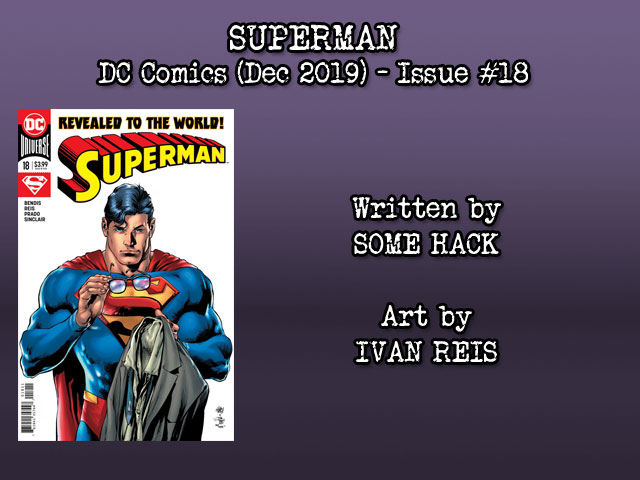
COMIC REVIEW – Superman #18 (Dec. 2019)

This comic book is a piece of shit.

So this is it, huh? This is the big issue where Superman holds a press conference and, after conferring with a few of his closest friends, he reveals the world that he and Clark Kent are one and the same and he’s going to be Superman from here on out.

Yes, we’re going back to this well again. DC because they figure if Superman does the outing rather than be outed by a third-party like the last time, this will turn out better… it didn’t. And also BENDIS because when it comes to costumed superheroes, the only card he has to play is the outing of the secret identity because he doesn’t believe in such things.

I’m struggling to read through this utter dreck and I find myself with an even bigger headache as I flip through page after page of some of the worst garbage imaginable. This whole thing comes off as a poorly thought out publicity stunt where we do the one thing and then move on to something else without rhyme or reason. One has to wonder if the fallout is going to invoke the same sort of consequence that begat Spider-Man or Daredevil when those IDs were revealed (and eventually retconned because they were fucking bad ideas.)

If this comes off as more of a crazed-driven rant than a review, then I offer a half-apology… but only because I thought I was reading something that was written by a competent writer and not some hack who got lucky with a bunch of Ultimate comics ages ago.

Oh well… at least the artwork is passable fare. Everyone looks like what they’re supposed to. It doesn’t look wretched. That’s fine.

In conclusion, Superman #18 by BENDIS is a piece of shit…

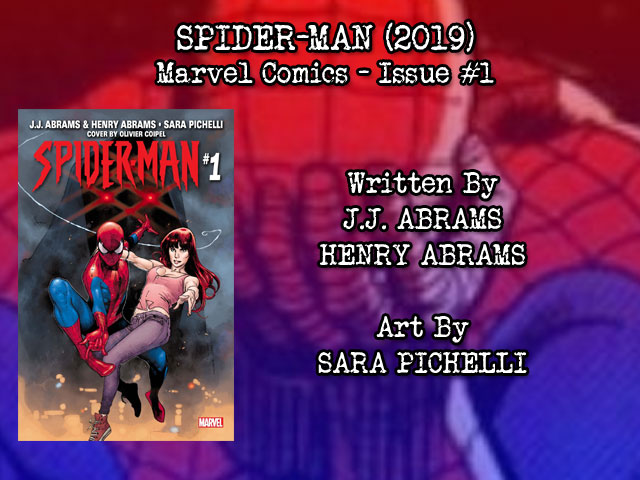
COMIC REVIEW: JJ Abrams and Son Presents Spider-Man #1

This comic book is terrible… there is no other way to say it.

Filmmaker and mystery box fetishist JJ Abrams and his son Henry were tasked with creating a Spider-Man comic book; a six-issue mini-series set in an alternate timeline where Peter Parker is no longer Spider-Man and a deadbeat dad with a son named Ben… Ben then turns to the Dark Side and joins the Knights Of Venom to become Kylo Venom… oh wait, I’m sorry. I got that mixed up.

So this book has a twist that involves a woman character and a refrigerator that sets up the current world this series is set in… hint: she’s the lady on the cover of this here comic book. This immediately pisses me off; not because of the tired woman in refrigerator gimmick that is a tired trope in and of itself, but it immediately gave me flashbacks of that one Spider-Man story where Spider-Man made a deal with the devil… only this time, the devil’s name is Abrams and he wears thick glasses.

And then we jump to the future; Peter is abroad, Ben is a dick kid, and then things change or whatever… this is the story of the kid taking up the mantle eventually and the mystery box that is the least interesting new villain in Caviar or Cadavaria or whatever his name is. The guy looks like something that even Rob Liedfeld would wince at. Think of the ground that covers.

If I can give Spider-Man #1 one sliver of credit, it’s that Sarah Pichelli’s artwork is rather gorgeous stuff. Honestly, she’s probably the only thing that makes this somewhat worthwhile, even with the somewhat muted color scheme that kills the splendor somewhat. It’s just too bad that it’s quality artwork attached to a wretchedly mediocre story.

I’ve no bone to pick with Abrams; I think he’s a perfectly fine filmmaker that gets a bit of a bad wrap at times for better or worse. With that having been said, this first chapter into the Abrams’ take on Spider-Man left a sour taste in my mouth and while I went into this with the best of intentions, it seems as though this is one mystery box that I would be perfectly content in leaving closed.

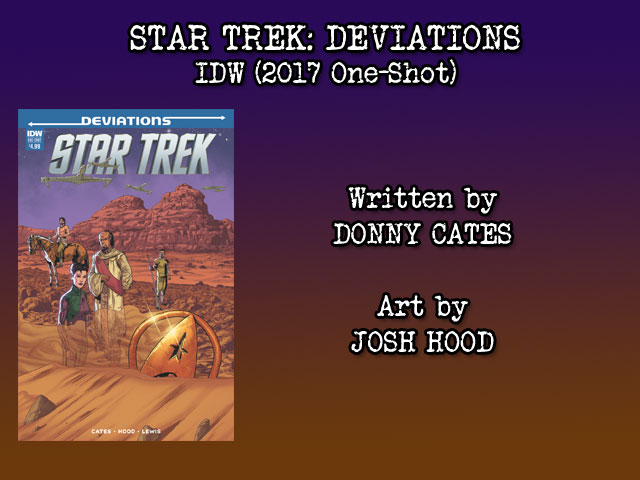
COMIC REVIEW – Star Trek: Deviations (IDW, 2017)

IDW is at it, again.

They’re doing another round of their Deviations event – one-shots of various licensed properties being subjected to “What If?” scenarios. We’ve sampled a couple of these last year and this year… well, there was only one that piqued my interest and that was the Star Trek one. Took me a little longer to gather my thoughts on this one because… well, let’s be honest here. I’ve read three of these Deviations so far and we’re one for three at the moment.

Yeah, this isn’t very good, either… but this time, the blame falls on the premise, which seems to be all over the place.

The premise of this Deviation seems fascinating on paper; what if, instead of the Vulcans, it was the Romulans who were Earth’s first encounter with extraterrestrials. It’s an idea that has potential to be explored and possibly spin off an interesting alternate take on Star Trek lore before we get to the eventual “everyone dies” ending that a lot of these things fall back on because we’re uncreative hacks or something.

So what happens when the Romulans land on Earth before the Vulcans? They turn the planet into a Romulan colony and enslave the human race. Jump ahead to the 24th century and an eyepatched Will Riker leads a ragtag band of freedom fighters (who, coincidentally or conveniently, happen to be some of the old TNG crew in similar altered states or worse) to find a man who may or may not know the location of a Federation base… wait, what? A Federation base? How could there be a Federation base if the Romulans enslaved the human race shortly after Zefram Cochrane’s warp flight? If the humans never had a chance to develop space flight, how could there be a Federation? Hell, that Delta on the cover shouldn’t even be there if that were the case.

So IDW either lied about the deviation or nobody had a fucking clue. I’m leaning more towards the former because IDW has been doing Star Trek comics for years now and they’re usually on the ball with this stuff. I’d have to assume that, at some point, the Federation and the Romulans got into a war, the Romulans won, took control of Earth and enslaved the humans. That would make more sense and less questions would be brought up that we’d never get answers to. Approaching the story from THAT context rather than the premise it was sold on… eh, it’s not so bad.

For what it’s worth, it’s a fast-paced piece of business that doesn’t waste time on exposition since we don’t have time to waste in a one-shot book. The action bits are well-done and it was interesting to see the different takes on these familiar TNG characters. Would it have been nice to get more emphasis on the main players and how things have changed? Sure, but given what’s there… it was fine.

It’s just unfortunate that for all the good bits that this issue offered, I am left with more questions regarding anachronistic aspects of the story, including the final big reveal, which – had this been following the original premise of the series – should not exist in the first place. I don’t know… this feels like a sampler of a much larger story and if there’s more to come, I’d look forward to reading it.

As a one-shot, however, Star Trek: Deviations leaves much to be desired.

COMIC REVIEW – Teenage Mutant Ninja Turtles: Deviations (IDW, 2016)

Of the half-dozen issues that IDW put out for its “Deviations” event – essentially a take on the “What If?” concept of alternate realities and the such – I’ve bought and read two books; one on Ghostbusters and one on Teenage Mutant Ninja Turtles. The Ghostbusters book had an interesting idea marred by poop jokes, low brow humor, and just bad writing overall.

The Deviations on Teenage Mutant Ninja Turtles, on the other hand? That fares a bit better. And that says something considering I haven’t been a regular follower of IDW’s (still ongoing) TMNT comic book… something that I eventually plan to rectify sooner than later, I hope.

This Deviation alters a plot point in the series, wherein the original narrative Leonardo is brainwashed into joining the foot clan, this narrative changes things by having all four Turtles brainwashed and in pursuit of their now-former master, Splinter. Although a familiarity with the original story in question may enhance one’s enjoyment of the story a bit, the book’s prologue provides enough of a backstory that bring those not in the know a little more up to speed. Who knows? Maybe it might entice potential readers to pick up back issues or the various trade paperback collections.

As for the issue itself, it’s not a bad read despite the story not being all that fantastic. The possessed Turtles almost become interchangeable caricatures of each other, with only slight hints of personality being shown and the lead up to the big battle at the end could’ve used a bit more meat. Regardless, I can’t say that I didn’t enjoy this book; the final battle at the end is certainly fun and the side story of Arnold Jones mulling over the loss of his son Casey (which triggered this whole thing to begin with) adds a bit of depth to a character that seemingly had none.

The art is fine, a bit messy at times, but it’s fine. I mean, as its own little thing, it’s a nice and somewhat believable story that’s saddled with a predictable ending (everybody dies, of course – hardly a spoiler if you’ve read a lot of What Ifs). An intimate knowledge of IDW’s take on the Turtles would certainly help, but this holds its own just fine as a standalone.